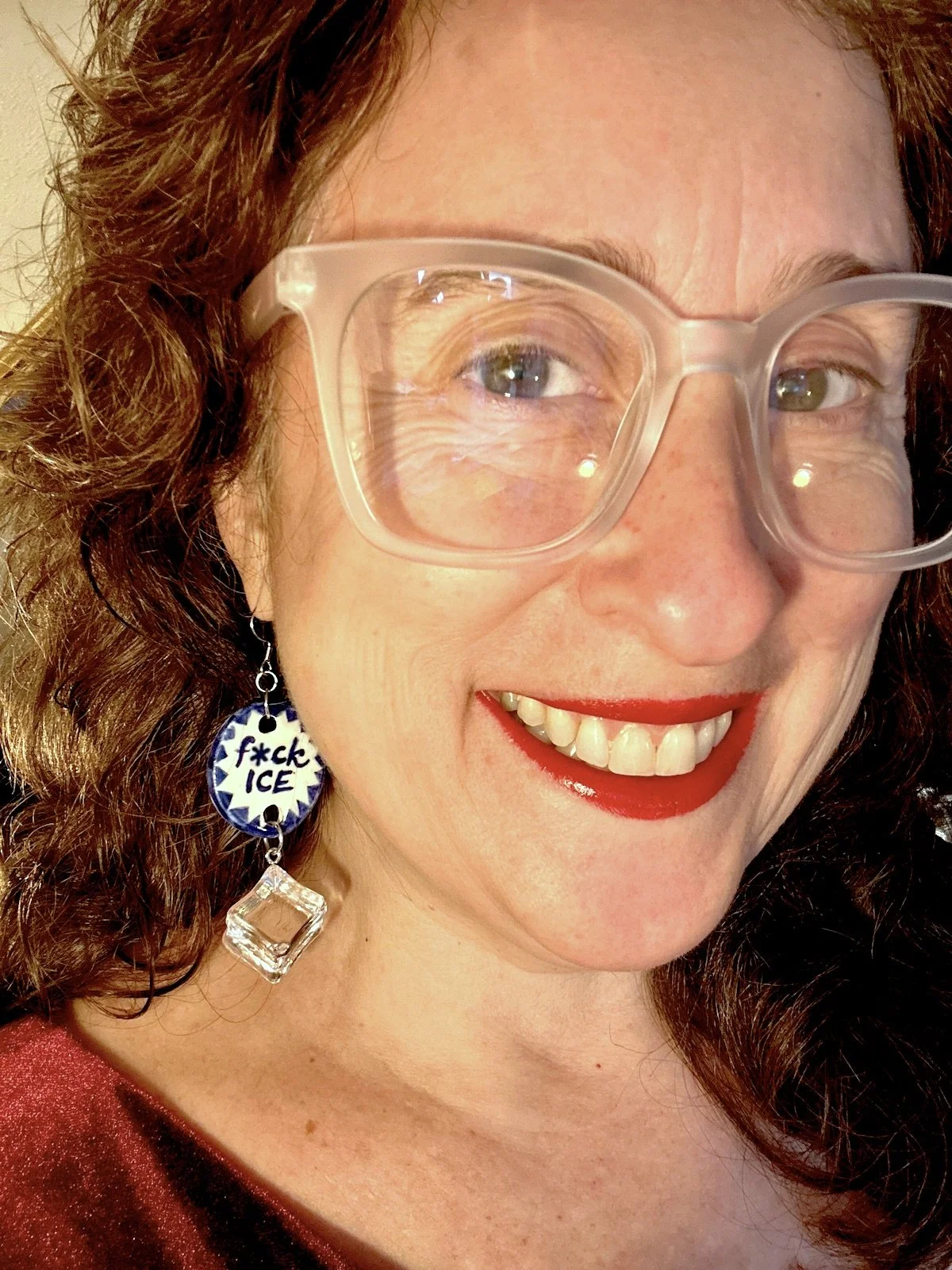
Anya Ulinich grew up in the Soviet Union, where she received early training in representational drawing, painting, and sculpture. After immigrating to Arizona at seventeen, she went on to receive a BFA from the School of the Art Institute of Chicago and an MFA from UC Davis. While primarily focusing on painting in her studio practice, Ulinich found that the psychology and politics of the immigrant experience had become her central creative obsessions — and that English itself, which she had learned as an adult, was emerging as her preferred medium. After moving to Brooklyn, she turned to fiction, exploring themes of identity, displacement, desire, and cultural translation in her debut novel, Petropolis.
Petropolis (Viking, 2007) was translated into ten languages and widely published internationally. It was named a Best Book of the Year by The Christian Science Monitor and The Village Voice, and Ulinich was selected as a National Book Foundation 5 Under 35 honoree. She has written for publications including The New York Times and The Wall Street Journal, taught writing at the New School, NYU, and Barnard, and served as a contributing art critic for The Forward.
While writing became her primary professional focus, image-making returned to the foreground in her second book, Lena Finkle's Magic Barrel (Penguin, 2014), a graphic novel written and drawn in ink, watercolor, and paper collage. The immediacy of these physical media reinforced the psychological directness of the book's semi-autobiographical narrative. Lena Finkle's Magic Barrel was named a New York Times Notable Book and a Best Book of the Year by the Los Angeles Times.
When Russia launched its full-scale invasion of Ukraine in 2022, Ulinich was working on a graphic novel based on her grandmother's experiences in 1941 Kyiv. For a Jewish-American artist with grandparents from Kyiv, Odesa, and Donetsk, Russia's atrocities felt intensely personal. It was as if, not even a century after the Holodomor and the Holocaust, genocidal history was repeating itself in real time.
Her practice split in two: she continued haltingly working on the novel, while also making daily oil paintings in response to the news of the war, which she followed battle by battle, village by village. Blunt and raw, based on reporters' photographs and social media videos, those paintings were never meant for the eyes of any selection committee.
As a 2023 MacDowell literature fellow, Ulinich found herself envying the painters and sculptors in residence — the immediacy of their process, the physicality of it. Literary work continued to feel too slow, too cerebral. The impulse was to go quiet and make things. As Russia kept bombing Ukrainian cities into ash and rubble, and later, as Israel's annihilation of Gaza continued unabated despite a flood of social media outrage, Ulinich turned to clay as her primary medium, embracing the technical challenges of ceramics. Objects, even fragile ones, even shattered ones, have a mute persistence when words feel ephemeral and ineffectual.
Her recent sculptural ceramics are shaped by that instinct. Fusing fragments of porcelain tchotchkes with clay and glaze, she recombines kitschy decorative elements into disturbing or uncanny hybrids, working with themes of ruin, waste, and the absurd endeavor of rebuilding a repeatedly shattered world. As a child visiting a Moscow museum, Ulinich had fallen in love with Palissy ware — French pottery dense with representations of plants, amphibians, and fish. Palissy's exuberant platters seemed like an antidote to the austerity of her Soviet childhood. In her current work, Ulinich reinterprets Palissy's celebration of natural abundance as an abundance of post-consumer, post-destruction detritus rendered in bright glazes, inviting and repellent at once.